
If you owe money to SARS and have no idea how to resolve it, you need to understand one thing above all else: SARS tax debt negotiation is possible, it is legal, and it works. Thousands of South Africans successfully negotiate their tax debt with SARS every year reducing what they owe, spreading payments over time, or in some cases getting a significant portion of the debt written off entirely.
But SARS tax debt negotiation is not something you can stumble into without preparation. There are formal processes, strict documentation requirements, tight deadlines, and specific legal frameworks that govern how the negotiation works. Get it wrong and you could end up in a worse position than before. Get it right ideally with the help of a registered tax practitioner and you could resolve years of outstanding debt on terms you can actually afford.
In this guide, we break down everything you need to know about SARS tax debt negotiation in 2026: what your options are, how the process works step by step, what documents you need, and what mistakes to avoid.
Why SARS Tax Debt Negotiation Has Never Been More Important Than in 2026
South Africa is currently sitting with approximately R646 billion in outstanding tax debt as of January 2026. Of that staggering figure, around R518 billion is classified as undisputed — meaning it is money SARS considers legally owed and is actively pursuing. This is not money under dispute or appeal. It is debt that taxpayers owe and have not paid.
In response, SARS has dramatically escalated its collection efforts. Under Project AmaBillions, SARS received an additional R7 billion in funding, recruited over 1,500 new debt collectors, and deployed advanced AI systems to identify and target non-compliant taxpayers. From January 2026 onwards, SARS confirmed it would escalate enforcement against taxpayers who have not engaged in SARS tax debt negotiation — including civil judgments, bank attachments, asset seizures, and even potential criminal prosecution for non-compliance.
The message from SARS is clear: those who engage in SARS tax debt negotiation proactively will be treated far more favourably than those who ignore the problem. And the good news is that SARS has formal, structured processes designed specifically to help taxpayers who cannot pay in full. These processes are your lifeline — but you need to use them before SARS uses its enforcement powers against you.
What Is SARS Tax Debt Negotiation and How Does It Work?
SARS tax debt negotiation refers to the formal process of reaching an agreement with SARS about how outstanding tax debt will be resolved. It is not an informal chat or a request for mercy — it is a structured legal process governed by the Tax Administration Act (TAA) and supported by SARS’s own internal policies and procedures.
There are three main forms of SARS tax debt negotiation available to South African taxpayers:
1. Payment Deferral Arrangement (Instalment Agreement)
A payment deferral is the most straightforward form of SARS tax debt negotiation. Instead of paying your full outstanding debt in one lump sum — which most people cannot afford — you negotiate with SARS to pay it off in monthly instalments over an agreed period.
This form of SARS tax debt negotiation is available to both individuals and businesses. SARS will typically agree to a payment deferral arrangement where:
- You acknowledge that the debt is valid and not in dispute
- You can show that immediate payment in full would cause you genuine financial hardship
- You commit to remaining compliant with all future tax obligations during the arrangement
- You provide supporting financial documentation to justify the instalment amount
Once your SARS tax debt negotiation results in a deferral arrangement, SARS generally pauses its aggressive enforcement actions — meaning no bank attachments, no sheriff visits, and no new judgments — for as long as you honour the agreement. However, interest continues to accrue during this period, which is why it is important to clear the debt as quickly as your finances allow.
Payment deferral arrangements can be requested through SARS eFiling, by calling the SARS Contact Centre on 0800 00 7277, or through your registered tax practitioner — which is the most effective approach for complex cases.
2. Debt Compromise (Write-Off of a Portion of Your Debt)
A debt compromise is the most powerful outcome you can achieve through SARS tax debt negotiation. Under a compromise agreement, SARS formally agrees in writing to accept a reduced amount as full and final settlement of your outstanding tax debt — effectively writing off the remainder.
This means your SARS tax debt negotiation could result in SARS waiving all accumulated interest and penalties, and in some hardship cases, even reducing the original capital amount owed. Once you pay the agreed settlement amount and remain compliant, SARS cancels the balance permanently. It is a legal, documented, and final resolution.
SARS tax debt negotiation through the compromise process requires you to demonstrate:
- That you genuinely cannot pay the full amount owed
- That you have fully and honestly disclosed your financial position
- That accepting a reduced amount is in the best interests of the fiscus — meaning SARS is better off accepting less now than pursuing a debt it may not be able to collect in full anyway
Critically, compromise applications must be submitted by a registered tax practitioner. SARS introduced an expedited compromise process in October 2025 and committed to resolving qualifying applications within four weeks using dedicated teams. This expedited process is now part of the standard framework for 2026, making SARS tax debt negotiation through compromise faster and more accessible than ever before.
3. Objection and Dispute (Where the Debt Is Not Correct)
The third form of SARS tax debt negotiation applies where you believe the amount SARS claims you owe is incorrect. SARS is not infallible — automated assessments can produce wrong results, especially if returns were not filed properly or information on file is outdated.
In these cases, your SARS tax debt negotiation starts with lodging a formal objection within the prescribed deadline (typically 30 business days from the date of the assessment). If your objection is disallowed, you can escalate to an appeal, and ultimately to the Tax Court if necessary.
One critical point: South Africa operates on a “pay now, argue later” principle. This means lodging an objection does not automatically suspend your obligation to pay. You need to separately apply for a suspension of payment while the dispute is being resolved — and this is another area where SARS tax debt negotiation by a professional makes a significant difference.
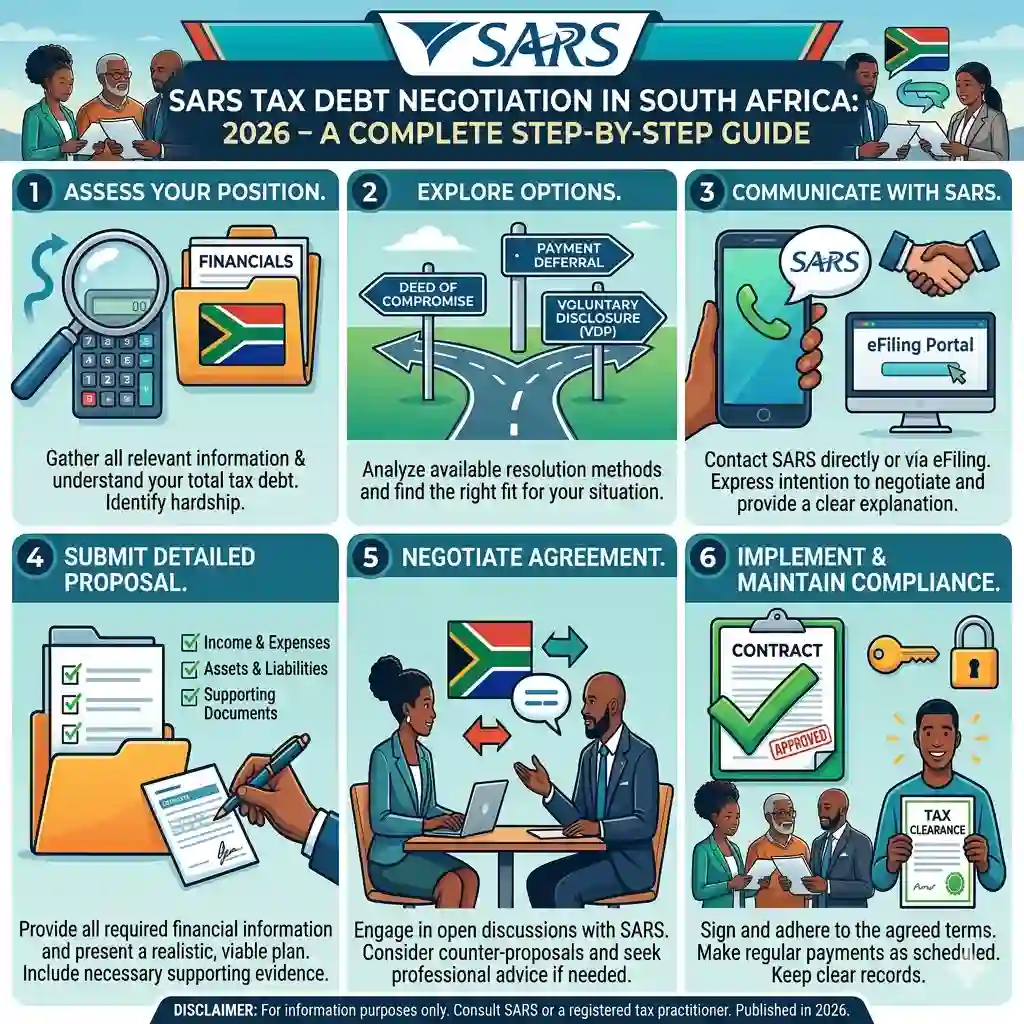
The SARS Tax Debt Negotiation Process: Step by Step
Understanding the mechanics of SARS tax debt negotiation helps you prepare properly and avoid costly mistakes. Here is how the process typically unfolds when working with a registered tax practitioner:
Step 1: Full Tax Position Assessment
Before any SARS tax debt negotiation can begin, you need a complete and accurate picture of your entire tax position. This means pulling your full statement of account from SARS eFiling, identifying every outstanding liability across all tax types (Income Tax, VAT, PAYE, SDL), reviewing all unfiled returns, and understanding exactly how much of your debt represents original capital versus accumulated interest and penalties.
Many taxpayers are surprised to discover during this step that a significant portion of their debt — sometimes more than half — consists of penalties and interest rather than actual tax owed. This is important because penalties and interest are the first thing written off in a successful compromise negotiation.
Step 2: Catching Up on Outstanding Returns
SARS will not engage meaningfully in any SARS tax debt negotiation if you have unfiled returns outstanding. Getting your returns up to date is a prerequisite for any formal arrangement. Your tax practitioner will file any outstanding returns, which also often has the effect of reducing your debt — because SARS’s auto-assessments for unfiled returns tend to overestimate what you owe.
Step 3: Preparing Your Financial Disclosure Documents
For any meaningful SARS tax debt negotiation — particularly a compromise — you will need to prepare detailed financial disclosure documents. These typically include:
- A completed Collection Information Statement (SARS form)
- Recent bank statements (typically 6–12 months)
- Latest financial statements or management accounts
- A statement of assets and liabilities
- Proof of income (payslips, business income statements)
- A detailed motivation letter explaining your financial circumstances and why a compromise or arrangement is warranted
The quality and completeness of these documents significantly affects the outcome of your SARS tax debt negotiation. Incomplete or inaccurate submissions can delay the process or result in rejection.
Step 4: Submitting the Application
Your registered tax practitioner submits the SARS tax debt negotiation application through the official SARS channel — either through eFiling, the dedicated compromise submission portal, or directly to SARS’s Debt Management department. For compromise applications, there is a dedicated single point of entry introduced in 2025 that streamlines the process.
Step 5: SARS Review and Response
SARS reviews your SARS tax debt negotiation application and supporting documentation. For compromise applications submitted through the expedited process, SARS has committed to resolving qualifying cases within four weeks. During this period, SARS may request additional information or clarification — your tax practitioner handles all of this communication on your behalf.
Step 6: Agreement, Payment and Closure
Once SARS accepts your SARS tax debt negotiation application, the agreement is formalised in writing. You pay the agreed settlement amount (either in one payment or in instalments as agreed), remain compliant with all future obligations, and SARS formally waives the balance. Your tax affairs are clean, your account is up to date, and you can move forward.
What Makes SARS Tax Debt Negotiation Succeed or Fail
Not every SARS tax debt negotiation succeeds. Here are the factors that most commonly determine the outcome:
Factors That Help Your Negotiation
- Honest and complete financial disclosure — SARS values transparency above all else. A fully documented, honest picture of your financial position builds credibility.
- Using a registered tax practitioner — SARS engages more constructively with registered practitioners who understand the process and speak the right language.
- Acting before enforcement begins — Proactive SARS tax debt negotiation gives you far more leverage than trying to negotiate after a bank attachment or judgment.
- Demonstrating future compliance — SARS wants to see that you are committed to meeting your obligations going forward. Having a plan to stay compliant strengthens your application.
- Making a realistic offer — Your settlement offer needs to be grounded in your actual financial capacity. An offer that is too low without sufficient justification will be rejected.
Factors That Hurt Your Negotiation
- Outstanding unfiled returns — SARS will not negotiate until your returns are up to date.
- Incomplete documentation — Missing documents delay or derail the process.
- Previous broken arrangements — If you had a prior payment arrangement with SARS and defaulted, this negatively affects your credibility in a new negotiation.
- Cases under criminal investigation or audit — These are excluded from the compromise process.
- Attempting to negotiate without professional help — While it is technically possible, self-represented SARS tax debt negotiation has a significantly lower success rate than practitioner-led applications.
How Accountants On Point Handles SARS Tax Debt Negotiation for You
At Accountants On Point, SARS tax debt negotiation is one of our core specialisations. We understand that dealing with SARS is stressful, confusing, and often frightening — especially when enforcement letters start arriving. Our job is to take that burden off your shoulders completely.
When you come to us with a SARS tax debt negotiation matter, here is exactly what we do:
- We pull your full SARS account history and conduct a complete tax position assessment
- We file all outstanding returns on your behalf, often immediately reducing your liability
- We identify which form of SARS tax debt negotiation — deferral, compromise, or dispute — gives you the best outcome
- We prepare all required financial disclosure documents and motivation letters
- We submit the application through the correct SARS channel and manage all communication with SARS on your behalf
- We negotiate the best possible settlement terms for your specific situation
- We put systems in place to ensure you remain compliant going forward so you never find yourself in this position again
Our clients don’t deal with SARS directly at all. We handle everything from start to finish, keeping you informed at every step.
Frequently Asked Questions About SARS Tax Debt Negotiation
Is SARS tax debt negotiation the same as asking SARS to write off my debt?
Not exactly. SARS tax debt negotiation covers a range of outcomes, from paying in instalments to a formal compromise where part of the debt is written off. A full write-off is only possible through the compromise process and only where you can demonstrate genuine inability to pay. The negotiation process determines which outcome is appropriate for your situation.
Can I do SARS tax debt negotiation myself without an accountant?
You can attempt to set up a basic payment arrangement through eFiling yourself. However, for compromise applications which offer the most favourable outcomes — SARS requires submission through a registered tax practitioner. Even for payment arrangements, having a professional handle your SARS tax debt negotiation dramatically improves your chances of a favourable outcome and protects you from making costly mistakes.
How long does SARS tax debt negotiation take?
Simple payment arrangements can be set up within days. Compromise applications under the expedited process introduced in 2025 are committed to a four-week resolution timeline for qualifying cases. More complex cases may take longer. Acting quickly is important — the sooner your SARS tax debt negotiation begins, the sooner enforcement actions stop.
Will SARS stop collecting while my negotiation is in progress?
Once a formal payment arrangement is in place and you are honouring it, SARS typically suspends aggressive enforcement. For compromise applications, your tax practitioner can apply for a suspension of payment while the application is being reviewed. It is important to have these protections formally in place an informal phone call to SARS does not legally protect you from enforcement.
What happens if I miss a payment during my negotiation arrangement?
Missing a payment is a serious problem. SARS can cancel the arrangement immediately and revert to full enforcement, including reinstating any debt that was previously suspended. If you are struggling to meet your payment obligations under an existing arrangement, contact your tax practitioner immediately to renegotiate before you miss a payment.
Can SARS tax debt negotiation include my VAT and PAYE debt, not just income tax?
Yes. SARS tax debt negotiation covers all tax types, including Income Tax, VAT, PAYE, SDL, and UIF. Your full tax position across all tax types is considered in any negotiation. Some exclusions apply for example, debt related to criminal investigations or active audits cannot be included in a compromise application.
What is the minimum amount of debt required to qualify for SARS tax debt negotiation through the compromise process?
There is no official minimum threshold published by SARS. The compromise process is available to any taxpayer who meets the qualifying criteria, regardless of the amount owed. However, SARS evaluates each case on its merits, and the cost and effort of preparing a compromise application needs to be proportionate to the amount of debt involved.
If I have a judgment against me from SARS, can I still negotiate?
Yes, you can still engage in SARS tax debt negotiation even if SARS has obtained a judgment against you. However, the situation is more complex and urgent. You will need to act immediately to prevent execution of the judgment (which could lead to bank attachments or asset seizures). A registered tax practitioner can apply for a suspension of execution while the negotiation proceeds.
Don’t Wait — SARS Tax Debt Negotiation Is Time-Sensitive
The longer you delay SARS tax debt negotiation, the more your debt grows through interest and penalties, the more enforcement options SARS uses against you, and the fewer options you have available. In 2026, SARS is operating at its most aggressive level in years — with over 1,500 new debt collectors, AI-powered tracking systems, and a mandate to recover R646 billion in outstanding debt.
But the law is on your side if you act correctly. SARS tax debt negotiation through a registered tax practitioner is legal, effective, and available to you right now — regardless of how long your debt has been outstanding or how much you owe.
At Accountants On Point, we specialise in SARS tax debt negotiation for individuals and small businesses across South Africa. Contact us today for a confidential, no-obligation consultation — and let us handle SARS so you don’t have to.
Get in touch with Accountants On Point now.
Disclaimer: This article is for informational purposes only and does not constitute formal tax or legal advice. Every taxpayer’s situation is unique. Please consult a registered tax practitioner for advice tailored to your specific circumstances.