
If you’ve been lying awake at night worrying about money you owe to SARS, you’re not alone. Millions of South Africans from small business owners to salaried employees are currently sitting with outstanding tax debt, and the pressure from the South African Revenue Service has never been greater.
The good news? You have options. Ignoring SARS is never the answer, but understanding your rights and the relief mechanisms available to you can make an enormous difference. In this guide, we walk you through everything you need to know about SARS tax debt help in South Africa in plain English, without the jargon.
Why SARS Tax Debt Is a Bigger Problem Than Ever in 2026
South Africa’s total outstanding tax debt has ballooned to over R646 billion as of January 2026. That’s not a typo it’s hundreds of billions of rands in unpaid tax sitting on SARS’s books. And SARS is no longer being patient about it.
Under a major enforcement initiative known as Project AmaBillions, SARS has received additional government funding, recruited over 1,500 new debt collectors, and is using advanced artificial intelligence and third-party data including banking and payroll records to track down taxpayers who owe money. They are contacting people via letters, emails, and now even WhatsApp messages.
If you have outstanding tax debt right now, SARS knows about it. And they are coming for it.
The important thing to understand is this: SARS would rather work with you than against you. They have formal, legal mechanisms designed to help taxpayers who genuinely cannot pay their full debt. But these mechanisms only work if you take action and take it quickly.
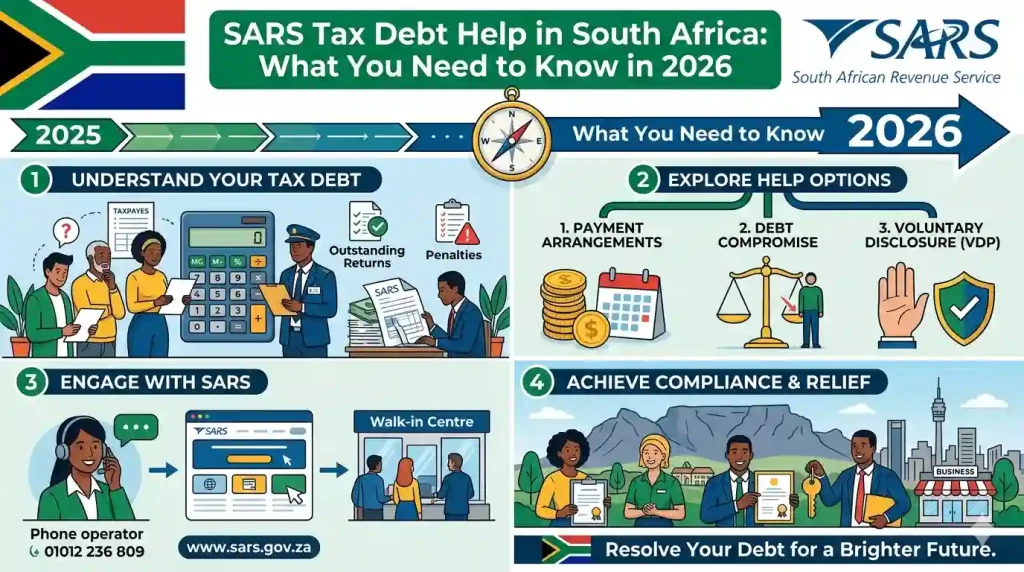
What Happens If You Ignore SARS Tax Debt?
Many people make the mistake of hoping the debt will go away, or that SARS won’t notice. This is one of the costliest mistakes you can make. Here’s what SARS can and does do when tax debt is left unaddressed:
- Penalties and interest accumulate: Your debt doesn’t sit still. SARS charges interest at the prescribed rate, and penalties can be added on top. A manageable debt can double or triple over a few years.
- Bank account attachments: SARS has the legal power to issue a “Third Party Appointment” meaning they can instruct your bank to deduct money directly from your account without going to court first.
- Asset seizure and sheriff visits: SARS can appoint a sheriff to seize and sell your movable assets, including vehicles and equipment.
- Judgments and blacklisting: SARS can obtain a civil judgment against you, which affects your credit record and ability to do business.
- Tax clearance certificate blocked: Without a valid tax clearance certificate, you cannot bid for government tenders, apply for certain loans, or emigrate financially.
- Retirement fund deductions: If you try to access your Two-Pot retirement savings, SARS can instruct the fund to deduct your outstanding debt before paying you out.
None of these are empty threats. SARS is actively enforcing all of these measures in 2026, and the earlier you seek help, the more options you will have.
The Main SARS Tax Debt Relief Options Available to You
South African tax law, specifically the Tax Administration Act (TAA), provides several formal mechanisms for taxpayers who are struggling with debt. Here is a breakdown of each one:
1. Payment Deferral (Instalment Arrangement)
This is the most common form of SARS tax debt help and the first thing most accountants will explore. A deferral arrangement allows you to pay your outstanding debt in monthly instalments over an agreed period rather than in one lump sum.
SARS will typically consider a deferral if:
- You acknowledge the debt is valid and not disputed
- You can demonstrate that paying the full amount immediately would cause financial hardship
- You remain compliant with all future tax obligations while the arrangement is in place
The arrangement is formalised in writing, and interest continues to accrue during the payment period. However, it stops the more aggressive collection actions like bank attachments and asset seizures as long as you stick to the agreement.
2. Compromise of Tax Debt
A compromise is a more powerful form of relief. Under a compromise agreement, SARS formally agrees to accept a reduced amount as full and final settlement of your tax debt effectively writing off a portion of what you owe.
This is not a quick or easy process, and it is not available to everyone. SARS will consider a compromise where a taxpayer can demonstrate:
- Genuine financial hardship or inability to pay the full debt
- That the taxpayer’s financial position has been fully and honestly disclosed
- That collecting the full debt would not be in the best interests of the fiscus
Importantly, the compromise can include the writing off of interest and penalties, meaning you may only need to settle the original capital amount owed. Once the agreed settlement is paid and you remain compliant, SARS waives the balance permanently.
A key point to note: compromise applications must be submitted by a registered tax practitioner. This is not something you can do on your own through eFiling. You need a qualified accountant or tax professional to prepare and submit the application on your behalf.
3. Disputing the Assessment
Sometimes the debt SARS claims you owe is not correct. SARS makes mistakes, and automated assessments can produce incorrect results especially if your tax returns weren’t filed properly or if there is missing information on file.
If you believe the debt is wrong in whole or in part, you have the right to lodge an objection. This involves submitting a formal objection with supporting documents within the prescribed timeframe. If your objection is disallowed, you can escalate to an appeal or even take the matter to the Tax Court.
One critical warning: under South Africa’s “pay now, argue later” rule, lodging an objection does not automatically suspend your obligation to pay. You must separately apply for a suspension of payment while the dispute is being resolved. A professional accountant will know how to handle both simultaneously.
4. Requesting a Suspension of Payment
Where you have lodged an objection or appeal, you can request SARS to suspend collection of the debt while the dispute is being resolved. SARS will consider factors such as whether you have a realistic prospect of success in your dispute, whether you will be able to pay if your dispute is unsuccessful, and whether there is a risk that you will dissipate your assets before the matter is resolved.
How a Professional Accountant Can Help You With SARS Debt
Dealing with SARS on your own is possible in theory, but in practice it is extremely difficult. The legislation is complex, the deadlines are tight, and the consequences of getting it wrong are severe.
A qualified accounting and tax firm with experience in SARS debt management can:
- Assess your full tax position Many clients don’t have a clear picture of exactly what they owe and why. An accountant will pull your full SARS account history and identify every outstanding liability.
- Communicate with SARS on your behalf You don’t need to deal directly with SARS at all. Your accountant can handle all correspondence and negotiations, which removes enormous stress.
- Identify the best relief mechanism for your situation Whether that’s a deferral, compromise, objection, or a combination of approaches depends on your specific circumstances. An experienced professional will know which route gives you the best outcome.
- Prepare and submit compromise applications These applications require detailed financial disclosure documents (including a Collection Information Statement), a motivation letter, and an offer amount. Getting this right significantly improves your chances of acceptance.
- Ensure you stay compliant going forward One of the conditions of any SARS arrangement is that you remain compliant. An accountant can take over your ongoing tax obligations to ensure you never fall behind again.
Red Flags: Signs You Need SARS Tax Debt Help Urgently
Sometimes people aren’t sure how serious their situation is. Here are the warning signs that you need to seek professional help immediately:
- You have received a final demand letter from SARS
- SARS has sent you a Third Party Appointment notice to your bank
- You received a WhatsApp or SMS from SARS regarding outstanding debt
- Your tax clearance certificate has been blocked or declined
- You have multiple years of unfiled returns alongside a debt
- Your debt has been growing for more than two years without a resolution
- SARS has issued a judgment or sent a sheriff to your premises
Any one of these situations requires immediate professional intervention. The longer you wait, the fewer options you have and the more the debt grows.
Steps to Take Right Now If You Have SARS Tax Debt
Here is a practical, step-by-step approach to getting your situation under control:
- Don’t panic, but don’t delay either. SARS has formal processes and the law protects your rights — but those rights have deadlines. Acting promptly gives you the most options.
- Get a full picture of what you owe. Log into SARS eFiling and check your statement of account. Note every outstanding return and every liability across all tax types (Income Tax, VAT, PAYE).
- Contact a registered tax practitioner. This is the most important step. Do not try to negotiate a compromise yourself — SARS requires registered practitioners for formal applications. Choose someone who specialises in SARS debt management, not just general tax filing.
- Gather your financial documents. Your accountant will need your bank statements, financial statements, proof of income, and details of your assets and liabilities to build your case.
- Respond to all SARS correspondence. Never ignore a letter or email from SARS. Even if you don’t know what to do, acknowledge receipt and inform them you are getting professional assistance.
- Commit to going forward compliance. Any arrangement you reach with SARS is conditional on you meeting all future obligations. Make sure you have systems in place to file and pay on time going forward.
Frequently Asked Questions About SARS Tax Debt Help
Can SARS really freeze my bank account without warning?
Yes. Under the Tax Administration Act, SARS can issue a Third Party Appointment to your bank or employer without needing a court order. This means money can be deducted directly from your account or salary. However, SARS is required to notify you of the outstanding debt before taking this step, so it doesn’t usually happen without prior correspondence. If you have received letters from SARS, treat them seriously and act immediately.
How much of my SARS debt can be written off?
There is no fixed percentage. Under a compromise agreement, SARS assesses each case individually based on your financial position. In some cases, interest and penalties which can represent a significant portion of the total debt are written off entirely, leaving only the original capital to be paid. In more severe hardship cases, even the capital may be reduced. The key is submitting a well-motivated, fully documented application through a registered tax practitioner.
Can I apply for a SARS debt compromise myself?
Technically, individuals can apply, but in practice, SARS’s compromise applications require complex financial disclosure documents and a carefully motivated application letter. More importantly, SARS works most effectively with registered tax practitioners. Attempting this on your own significantly reduces your chances of success. Always use a qualified professional for compromise applications.
What if I can’t afford to pay anything right now?
This is exactly the situation that the compromise process is designed for. If you can demonstrate genuine financial hardship with supporting documents, SARS has the legal authority to accept a settlement that you can actually afford — including writing off the interest, penalties, and in some cases a portion of the capital. The worst thing you can do is nothing. There are options available even in the most difficult financial situations.
Will SARS debt affect my credit record?
SARS debt itself does not automatically appear on your credit bureau report. However, if SARS obtains a civil judgment against you (which they are increasingly doing as part of their 2026 enforcement strategy), that judgment will appear on your credit record and can affect your ability to get loans, open accounts, or enter into financial agreements.
How long does a SARS compromise take?
SARS has committed to resolving qualifying compromise applications within approximately four weeks for straightforward cases, using dedicated teams. More complex cases involving multiple tax types or large amounts may take longer. The process includes submitting the application, SARS reviewing your financial disclosure documents, and formal agreement on the settlement amount and payment terms.
Does an instalment arrangement with SARS stop interest from accruing?
No, interest continues to accrue during a deferral arrangement. This is one of the reasons why it is important to resolve your debt as quickly as possible. The interest rate prescribed by SARS is significant, and over a period of years, interest can add substantially to your total liability. A compromise, on the other hand, can include the writing off of all accrued interest.
I haven’t filed my tax returns for several years. Can I still get help?
Yes in fact, getting your unfiled returns submitted is one of the first steps any good tax accountant will take on your behalf. Outstanding returns attract auto-assessments and additional penalties, which can dramatically inflate your debt. Once your returns are up to date, SARS can work with you on the actual debt. Many people are surprised to find that once properly filed, their actual liability is far less than the inflated estimates SARS had on file.
The Bottom Line: Don’t Face SARS Alone
SARS tax debt is a serious problem, but it is a solvable one. South African law gives taxpayers meaningful rights and real options from payment arrangements to formal compromise agreements that can significantly reduce what you owe. The critical factor is taking action before SARS does.
In 2026, SARS is more aggressive than it has ever been. Project AmaBillions, the recruitment of thousands of new debt collectors, and the use of AI and banking data to track down unpaid tax means the window for proactive resolution is narrowing.
The right move is to get qualified, experienced help on your side someone who knows the system, knows your rights, and knows how to negotiate the best possible outcome for your situation.
At Accounts On Point, we specialise in SARS tax debt management for individuals and small businesses across South Africa. We deal with SARS on your behalf, explore every available relief option, and help you get back on track financially and mentally.
Contact us today for a confidential consultation. The sooner you act, the more we can do to help you.
Disclaimer: This article is for informational purposes only and does not constitute formal tax or legal advice. Every taxpayer’s situation is unique. Please consult a registered tax practitioner for advice specific to your circumstances.